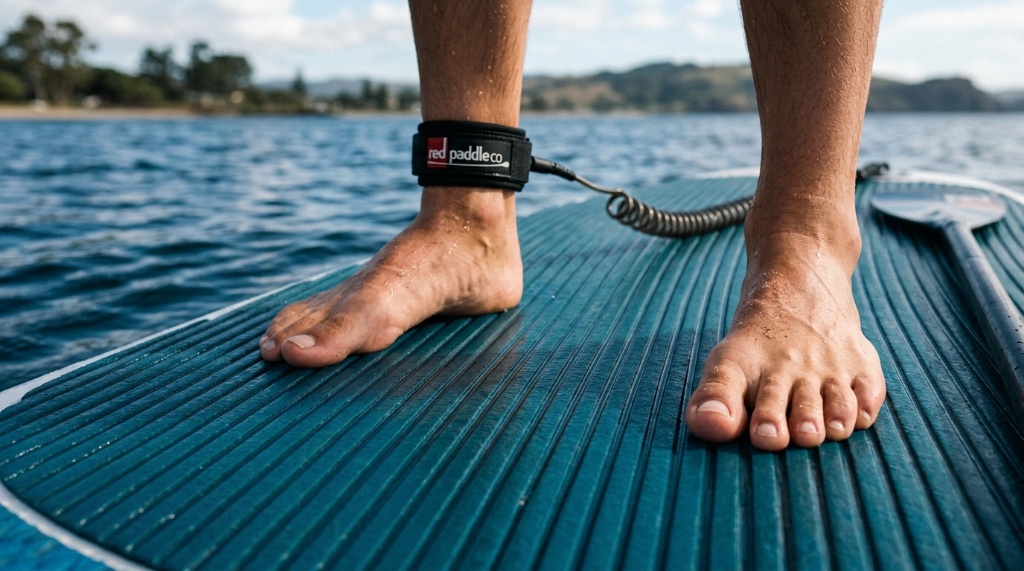
Most paddle board falls happen in the first twenty minutes on the water, and almost none of them are caused by bad balance. They are caused by standing up too fast, gripping the rail with your toes, and staring at your feet instead of the horizon. New paddlers tend to treat a board like a floor, but it behaves more like a slow-moving platform that responds to every shift in weight. If you are also dialing in your gear before you head out, a solid starting point is understanding how fast your board should be inflated, and this HydroHero 12v electric paddle board pump review and specs covers the pressure settings that make a board stable in the first place. The technique below is what actually keeps you upright once you push off.
Quick Answer
Improve paddle board balance by standing on the center of the board with feet shoulder-width apart, keeping your knees slightly bent, your head up, and your weight centered over the middle of the deck. Paddle continuously rather than stopping, because a board with forward momentum is far more stable than a stationary one. Practice in calm, waist-deep water first, then add chop and distance.
Key Takeaways
- Board stability depends on three things: your stance, your board’s inflation pressure, and whether you are moving or standing still.
- Keeping your knees bent and your gaze on the horizon prevents the overcorrection that causes most falls.
- Continuous paddling adds stability through forward momentum, so beginners should avoid pausing mid-stroke.
- Wider boards with more volume are easier to balance on, but they are slower and heavier to carry.
- A board pumped to its recommended PSI feels dramatically more rigid and stable than an under-inflated one.
Why Balance on a Paddle Board Feels Harder Than It Looks
A paddle board is an unstable platform with a small footprint relative to your body height. When you stand on it, your center of gravity sits high, and any small wobble travels up through your legs and hips. The board does not push back the way a floor does. It floats, flexes slightly, and drifts with the water beneath it.
That is why two people of similar fitness can have completely different experiences on the same board. The difference is usually not core strength. It is how they position their weight and how quickly they correct a wobble.
Under-inflation makes this worse. A soft board sags in the middle, which raises the rails and creates a rounded, unstable surface. Even a strong paddler will struggle on a board pumped well below its recommended pressure. Rigidity equals stability, which is why the electric pump settings covered in that HydroHero review matter more than most beginners expect.
The Stance That Actually Keeps You Upright
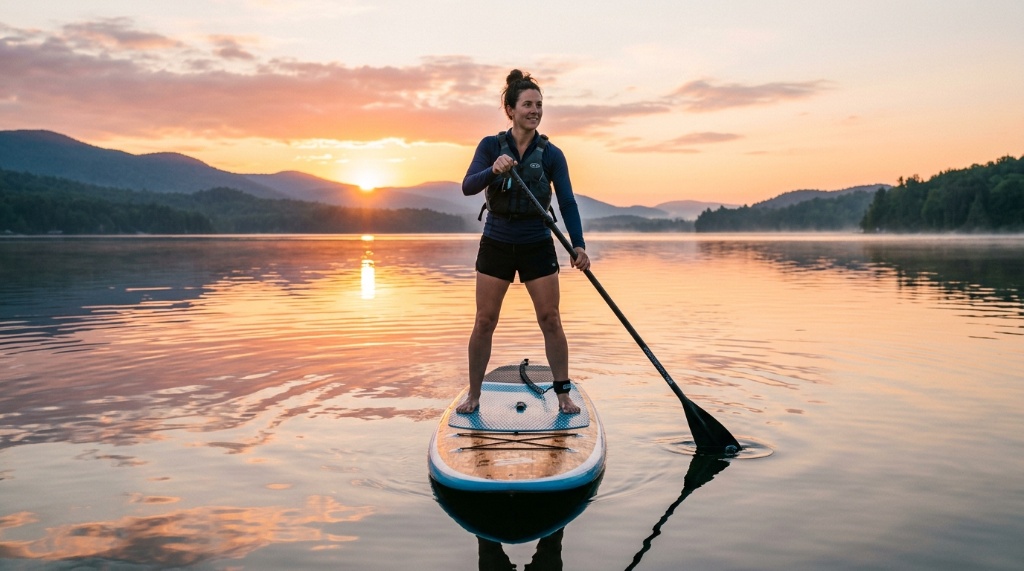
Stand with your feet roughly shoulder-width apart, positioned so the handle or center point of the board sits between them. Your weight should be centered, not shifted forward or back.
Then add three adjustments that most beginners skip:
- Bend your knees slightly. Locked knees turn your body into a rigid lever that tips easily. Bent knees act as shock absorbers.
- Keep your head up and look at the horizon. Looking at your feet forces your upper body forward and shifts your center of gravity toward the nose.
- Relax your grip and hips. A death grip on the paddle makes your upper body stiff and reduces your ability to make small corrections.
The most common mistake is standing with feet parallel and toes pointed straight ahead. A slight rotation of the feet outward, combined with a small amount of hip movement, gives you a wider base to work with.
Get On the Board the Right Way
Most falls happen during the transition from kneeling to standing. A rushed pop-up is the single biggest cause.
- Start on your knees in the center of the board, hands on either side of the deck pad.
- Place the paddle across the board in front of you for support.
- Bring one foot forward and plant it flat where your knee was.
- Shift your weight onto that foot and bring the other foot up, keeping both feet centered.
- Rise slowly, keeping your knees bent, and do not straighten up fully until you feel settled.
If you feel unstable at any point, stop and go back down to your knees. The sequence matters more than the speed.
How Your Board’s Setup Affects Stability
Balance is not just about your body. Your board’s shape, volume, and pressure directly influence how forgiving it feels.
| Factor | More Stable | Less Stable |
|---|---|---|
| Width | Wider (32 inches and up) | Narrow (under 30 inches) |
| Thickness/Volume | Thicker boards (5–6 inches) | Thin boards (under 4 inches) |
| Inflation Pressure | At recommended PSI | Under-inflated |
| Fin Setup | Larger center fin, or three fins | Single small fin |
| Board State | Moving forward | Stopped or drifting |
A wider board is not automatically better. It is more stable at rest, but it is slower to turn and harder to carry. For flat-water cruising and beginners, width is a worthwhile trade-off. For touring or distance paddling, a slightly narrower board becomes more efficient once your balance improves.
Use Your Paddle for Support, Not Just Propulsion
Your paddle is effectively a third leg. Skilled paddlers use it to stabilize, not only to move forward.
Here is how to do the same:
- Keep the blade in the water as much as possible. A blade planted in the water gives you something to lean against.
- During a wobble, press down on the paddle rather than lifting it. Downward pressure into the water re-stabilizes you quickly.
- Use a wide, low stance when the water gets choppy. A wider stance combined with the paddle touching the water is your most reliable recovery position.
The single most effective habit you can build is simply paddling continuously. A moving board tracks straighter and resists side-to-side tipping. Standing still on flat water is actually harder than moving, because you lose the stabilizing effect of forward motion.
Progressive Practice That Actually Builds Balance
Balance improves faster when you practice in a sequence rather than trying everything at once.
- Kneel, then stand (calm, waist-deep water). Stay near shore where you can stand up if you fall.
- Paddle a straight line for 100 meters. Focus on keeping your head up and your blade in the water.
- Practice turning. Turns force you to shift weight from rail to rail, which builds control.
- Add light chop. Move to slightly textured water once flat water feels routine.
- Add distance and wind. Longer outings build endurance and the micro-adjustments that prevent fatigue-related falls.
Roughly, expect a few sessions before flat-water paddling feels natural, and several more before choppy water does. Falling is normal. Falling repeatedly at the same moment is a signal to adjust your stance or your pressure, not a sign you are hopeless at it, For more buying guidance, check out our guide on how to choose an affordable inflatable paddle board without wasting money.
Mistakes That Undermine Your Stability
- Standing before the board is fully inflated. A soft board wobbles no matter how good your stance is.
- Locking your knees. This removes your ability to absorb movement.
- Looking down at your feet. This shifts your weight forward.
- Standing too far forward or back. Move back to the center point of the deck.
- Stopping the paddle to rest. Pausing mid-water removes your stabilizing third contact point.
- Wearing bulky footwear. Flat, thin water shoes or bare feet give you better deck feel than thick soles.
When to Consider a Different Board
If you have worked on your stance, your pressure, and your paddle technique for several sessions and still feel unstable, the board itself may be the limiting factor.
Signs your board is working against you:
- It flexes noticeably under your feet even at recommended pressure.
- It is narrower than 30 inches or thinner than 4 inches.
- It is a dedicated racing or touring shape.
- It has minimal volume for your body weight.
In these cases, a wider all-around board or a higher-volume inflatable will make more of a difference than additional practice. Balance training has limits when the platform is designed for speed rather than stability.
Frequently Asked Questions
How long does it take to improve paddle board balance?
Most beginners feel reasonably stable on flat water after two to four sessions. Balance in choppy water or wind typically takes longer, often several weeks of regular paddling.
Does core strength matter for paddle board balance?
It helps, but it is not the main factor. Stance, gaze direction, inflation pressure, and continuous paddling affect stability far more than raw core strength for beginners.
Is a wider paddle board always more stable?
Wider boards are more stable at rest and in chop, but they are slower and heavier. The best width depends on whether you prioritize stability or speed.
Should I inflate my board to the maximum PSI?
Inflate to the manufacturer’s recommended range, which is usually printed near the valve. Higher pressure within that range increases rigidity and stability, but exceeding the maximum risks damage.
Why do I fall more when I stop paddling?
A stationary board loses the stabilizing effect of forward momentum. Paddling continuously gives you a third contact point and a tracking direction that resists tipping.
Can I improve balance without getting in the water?
Yes, to a limited degree. Balance boards and single-leg exercises help, but they do not replicate the specific instability of a floating board. Water time is still the main driver.
Conclusion
Better balance on a paddle board comes down to a few repeatable habits: stand centered with bent knees, keep your eyes on the horizon, paddle continuously, and make sure your board is inflated to its recommended pressure. Practice in calm, shallow water first, then add chop, wind, and distance as your stability improves. If you have done all of that and still feel unsteady, the board’s width, volume, or rigidity may be the real issue rather than your technique.