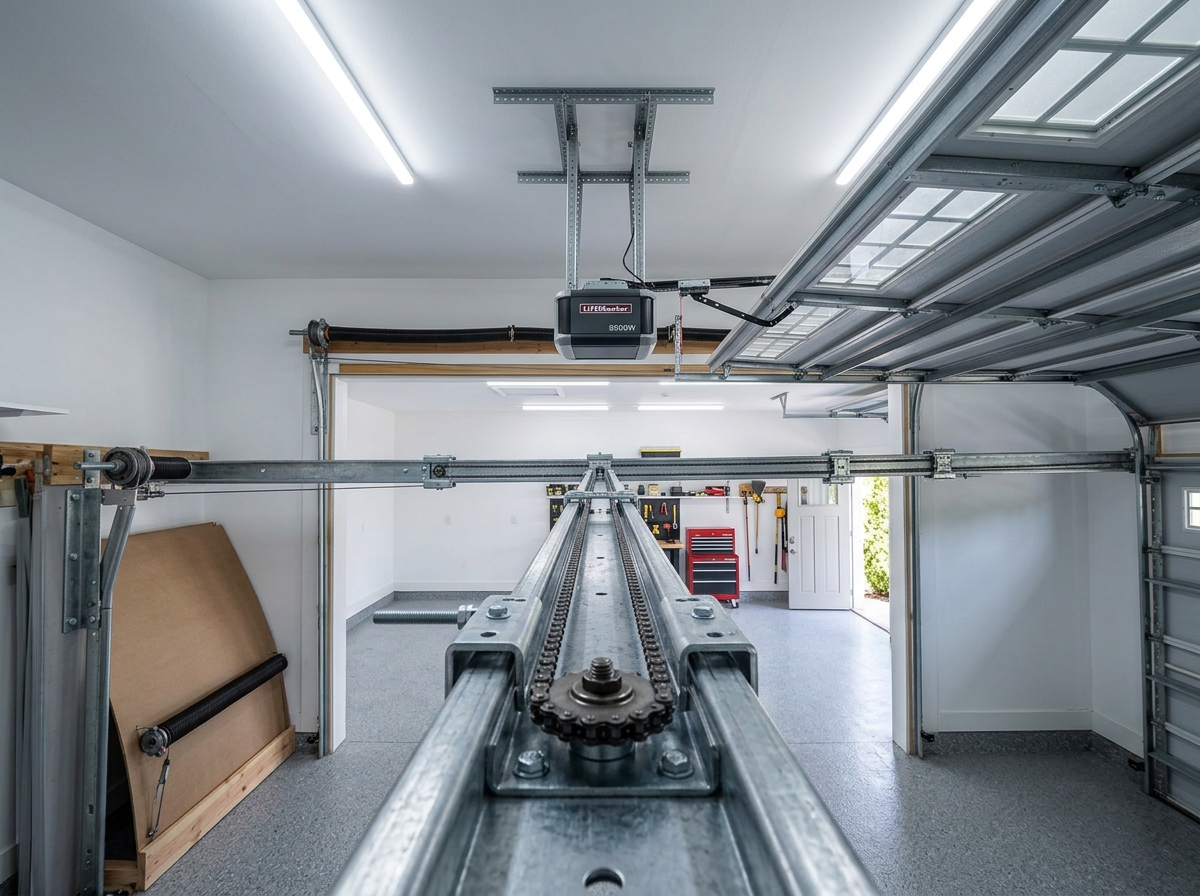
Opener performance depends partly on a detail homeowners may overlook: the rail between the motor and the door. Correct sizing lets the trolley travel far enough to lift the door fully without forcing the system beyond its intended range. Small measurement errors can leave a door hanging too low, create strain, or complicate garage door opener installation.
Rail Length Has to Match the Height of the Garage Door
Standard opener rails are designed around common door heights, so installers measure the door first. Height determines how far the trolley needs to move to pull the top section through the curved track and into the open position. Installers also consider track radius and mounting geometry because two doors with the same height can still need different setup details. Matching those dimensions helps prevent a rail from reaching its limit before the door completes its travel.
A Rail That Is Too Short Can Limit Full Door Travel
Short rails can stop the trolley before the door rises high enough for vehicles, roof racks, or taller equipment to pass underneath. Restricted travel may leave the bottom section hanging below the header even after the opener reaches its stopping point. Repeated operation can place unusual stress on the top section and opener arm.
Incomplete opening is sometimes mistaken for a programming problem when the real issue is rail length. Clearance checks can show whether the trolley simply lacks enough room to move farther toward the motor. Homeowners searching for a garage door repairman near me may need a technician to compare door height, rail length, travel settings, and track geometry before deciding what needs correction.
Taller Doors Often Need an Opener Rail Extension
Taller residential doors commonly require a manufacturer-approved rail extension so the opener can provide enough trolley travel for the added height. Extensions are designed for specific opener models and drive systems, so a random piece of rail should not be treated as a universal substitute. Manufacturers may pair extension kits with longer chains, belts, or drive components so the assembly maintains its intended range. Trying to adapt an undersized rail can create alignment problems and may interfere with warranty requirements.
Proper Rail Sizing Helps the Door Open to the Right Height
Adequate rail length lets the opener lift the door high enough for the bottom section to clear the opening without pulling the trolley into an awkward end position. Fully opened doors should sit where the track system and opener design expect them to, leaving useful clearance below. Accurate positioning matters during garage door installation because track height and opener geometry need to work together.
Travel limits still need adjustment after the correct rail is installed. Settings tell the motor where to stop, but they cannot create extra distance on a rail that is too short. Technicians fine-tune those limits after confirming that the door moves freely and the opener has enough rail length to complete its travel.
Rail Length Affects Trolley Position and Opener Movement
Trolley placement influences how the opener arm pulls the top section and how smoothly the door shifts from vertical to horizontal travel. Position that is too far forward or back can change the arm angle, especially near the fully closed or open positions. Poor geometry may cause jerking, excess panel pressure, or rough movement through the curved track. Smooth operation comes from matching rail length, trolley range, mounting height, and door travel instead of relying on one adjustment.
The Wrong Rail Size Can Put Extra Strain on the Opener
Incorrect rail sizing can make the motor work against an unnatural stopping point instead of guiding the door through a complete cycle. Extra load may reach the trolley, carriage, belt, chain, sprocket, or top bracket if the opener keeps pulling after available travel runs out. Over time, repeated stress can shorten component life and make a newer opener sound louder or feel less responsive.
Mechanical problems elsewhere can make symptoms harder to diagnose because a weak spring or binding track may also cause slow or incomplete travel. Anyone searching for an overhead door company near me should expect the technician to check door balance before blaming the rail or motor alone. Replacing garage door spring components may be necessary first if poor balance is forcing the opener to handle more weight than designed.
Measuring Door Height First Helps Avoid Installation Problems
Measuring the finished door height before equipment is ordered gives installers the information needed to choose the right opener package, rail, and extension kit. Door dimensions should be checked alongside ceiling clearance, backroom, track layout, and beams, lights, storage racks, or other obstacles. Ceiling conditions may affect motor placement even if the rail itself is long enough. During garage door opener installation, those measurements help keep the rail level, the trolley within its intended range, and the opener arm at a workable angle. Snappy Doors can evaluate door height, rail requirements, opener compatibility, and related mechanical conditions before installation, while also providing garage door installation, opener service, spring replacement, and repair when broader work is needed.