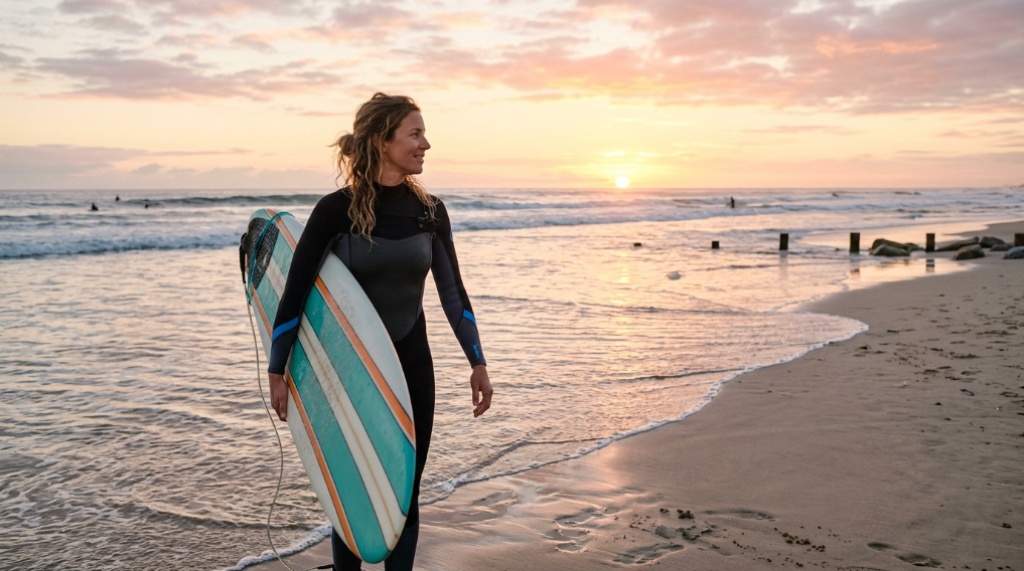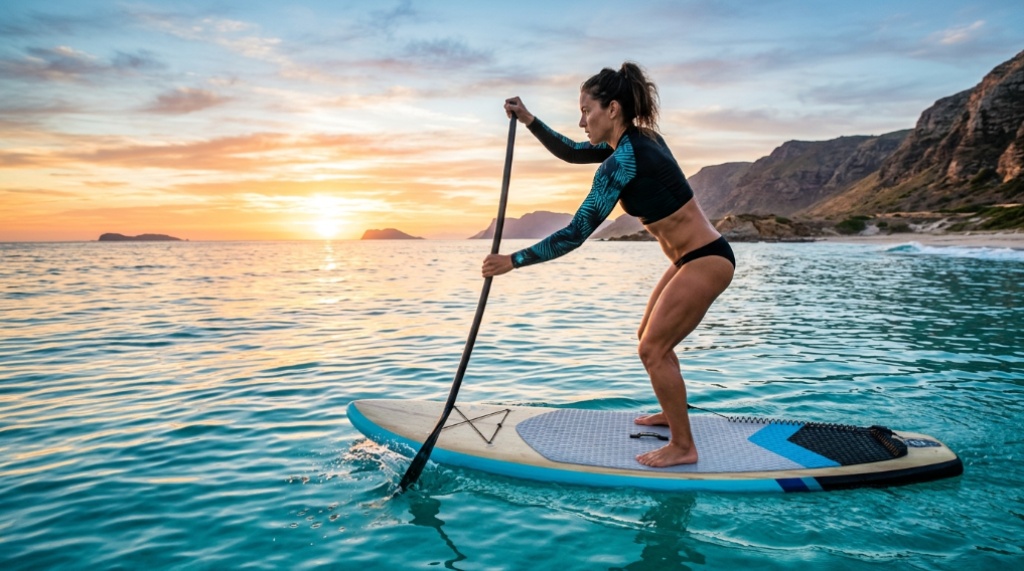
You paddle out onto a calm Oregon lake, and within ten minutes your shoulders are burning, your core is trembling, and your legs feel like you have been balancing on a tightrope. That is not a coincidence. Stand-up paddleboarding quietly works nearly every major muscle group, which is why so many people treat it as a genuine workout rather than a lazy float. If you are still deciding what to ride, a budget inflatable paddle board for beginners in Oregon can get you on the water affordably while you build the strength and balance this sport demands.
Quick Answer
SUP is a full-body workout that primarily targets your core, shoulders, upper back, arms, and legs. The oblique and deep abdominal muscles stabilize every stroke, the deltoids and latissimus dorsi drive the paddle, and the quadriceps, glutes, and calves constantly micro-adjust to keep you balanced. Your heart and lungs work continuously too, making it both a strength and cardiovascular exercise.
Key Takeaways
- SUP engages your core more than most people expect because balance demands constant small corrections, not just during strokes.
- The pulling phase of a stroke recruits your lats and upper back, while the pushing arm relies on the shoulder and triceps.
- Your legs work harder in choppy water or on an unstable board, so conditions and board type change the intensity.
- Paddleboarding builds muscular endurance rather than raw max strength, so it complements gym training rather than replacing heavy lifting.
- Beginners often feel the workout in the shoulders and low back first, which usually signals technique that needs adjusting.
What Muscles Does SUP Actually Use?
Nearly every major muscle group contributes to paddling, but the workload is not evenly distributed. The core, shoulders, back, and legs do the bulk of the work, and the intensity in each area shifts depending on your technique, the water conditions, and how stable your board is.
Core: The Hidden Engine of Every Stroke
Your core is the most continuously active muscle group in SUP, even though you may not feel it the way you feel your arms. The rectus abdominis, obliques, and transverse abdominis work together to keep your torso upright and transfer power from your hips into the paddle. Every time the board rocks slightly, those muscles fire to correct your posture before you consciously notice the movement. This is why a long paddle session can leave your midsection sore the next day even if you never did a single crunch.
Shoulders, Arms, and Upper Back
The stroke itself is where your upper body does its heaviest work. Your top hand pushes down while your bottom hand pulls, which recruits the deltoids, triceps, and forearm muscles. The pulling phase is driven largely by the latissimus dorsi and the rhomboids and trapezius in your upper back. Beginners often overuse the shoulders and underuse the back, which is a common reason for early fatigue and shoulder soreness, If you are planning a coastal paddle session, make sure you check out how to choose the right surf apparel for different beach conditions to stay comfortable and protected on the water.
Legs and Glutes: Stability Under Constant Load
Your legs rarely move dramatically, but they are never fully at rest. The quadriceps, hamstrings, glutes, and calves make constant micro-adjustments to keep the board level and your weight centered. On a narrower or less stable board, this stabilizing work increases sharply. After a windy session or a stretch of choppy water, many paddlers feel their legs more than their arms.
Secondary Muscles You Might Not Notice
Grip strength gets a steady workout from holding the paddle, and your neck and upper traps help keep your head up and your gaze forward. If you paddle in a kneeling position, your hip flexors and lower back take on extra load. None of these are the headline muscles, but they contribute to the overall fatigue you feel after a longer session.
Is SUP Really a Full-Body Workout or Just an Arm Exercise?
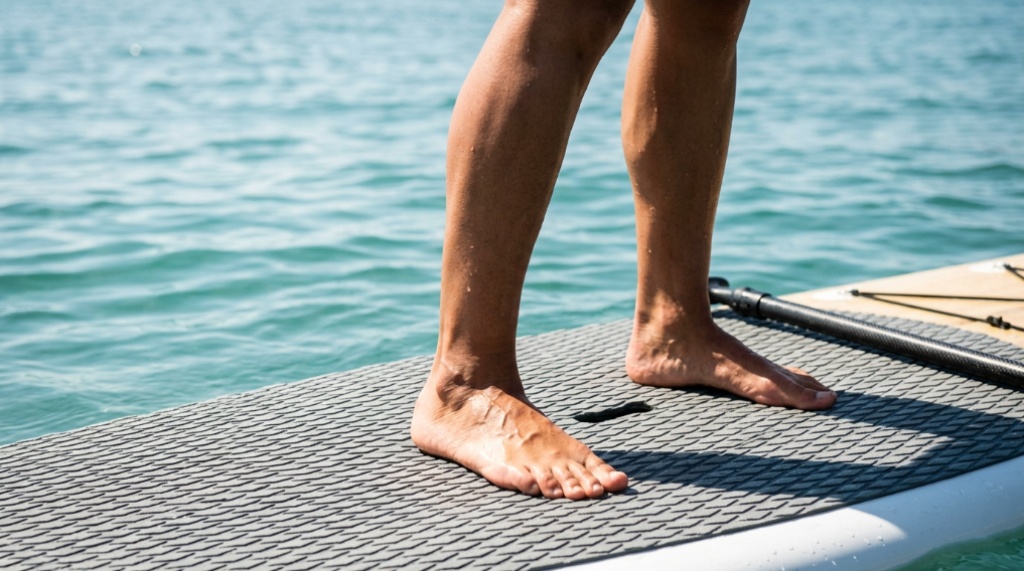
It is genuinely a full-body workout, but the balance between upper and lower body depends heavily on how you paddle. Paddlers who rely mostly on their arms exhaust quickly and miss much of the benefit. Paddlers who rotate their torso, engage their hips, and drive power from their core distribute the effort across far more muscle groups and can sustain longer sessions.
The cardiovascular component is also easy to underestimate. Continuous paddling at a moderate pace raises your heart rate and keeps it elevated, similar to brisk walking or light jogging. Add wind, current, or choppy water, and the intensity climbs quickly. That combination of resistance training and steady cardio is what makes SUP feel like a real workout rather than a passive float.
How Board Choice and Water Conditions Change the Workout
The same paddler can get very different workouts on different days, and the board itself is a major factor. A wider, thicker inflatable board is more stable, which reduces the balance demand on your legs and core. A narrower or lower-volume board forces more constant adjustment and recruits more stabilizing muscle.
Water conditions matter just as much. Flat, calm water lets you focus on stroke technique and upper-body endurance. Wind, boat wakes, and current add instability that shifts effort into your legs and core. If you paddle into a headwind, you will feel your lats, shoulders, and even your grip working noticeably harder. Beginners on very stable boards may find the workout feels light at first, while the same person on a slightly less stable board will feel significantly more muscle engagement within minutes.
| Factor | Effect on Muscle Demand |
|---|---|
| Wider, thicker board | More stable; less leg and core demand |
| Narrower or lower-volume board | Less stable; more stabilizing work for legs and core |
| Calm flat water | Emphasis on upper body and stroke endurance |
| Wind, chop, or current | Added core and leg work; higher overall intensity |
| Longer sessions | Greater muscular endurance demand across all groups |
What SUP Does Not Do Well
SUP is excellent for muscular endurance, balance, and low-impact cardio, but it is not a complete replacement for all training. It does not build maximal strength the way heavy resistance training does, because the load is limited by water resistance and paddle mechanics. It also does not provide much direct work for the chest, and it will not build significant muscle mass on its own.
If your goal is general fitness, weight management, or cross-training, SUP fits well. If your goal is building raw strength or muscle size, treat paddling as a complement to a structured strength program rather than the main event. Understanding that limitation helps you set realistic expectations and avoid the frustration of expecting the wrong results.
Common Beginner Mistakes That Reduce the Workout
Several habits quietly undermine both your technique and your results, especially in the first few sessions. Fixing them early makes paddling more efficient and more effective as a workout.
- Paddling with your arms only instead of rotating your torso, which fatigues the shoulders and skips the core.
- Standing too upright and stiff, which reduces balance feedback and forces your lower back to compensate.
- Gripping the paddle too tightly, which drains forearm and grip strength early.
- Looking down at the board instead of ahead, which throws off posture and balance.
- Choosing a board that is far too unstable for your current skill level, which turns the session into a struggle instead of a workout.
If your lower back or shoulders are the first things to fatigue, technique is usually the cause rather than a lack of strength. Slowing down, focusing on torso rotation, and keeping your knees slightly bent will shift the load into the muscles you actually want to train.
How to Get More Out of a SUP Session
Once basic balance feels comfortable, you can adjust several variables to make paddling a harder or more targeted workout. The key is to change one thing at a time so you can tell what is actually making the difference.
- Increase your cadence gradually instead of sprinting early and burning out.
- Paddle into the wind or against a mild current for part of the session to raise resistance.
- Practice pivot turns and stepping back on the board to challenge balance and leg strength.
- Extend session length over time rather than pushing intensity every outing.
- Add short bursts of fast paddling between steady stretches to build cardiovascular capacity.
These adjustments work because they increase either resistance, instability, or duration, which are the three main levers for progressing any endurance-based workout. You do not need special equipment to apply them, just a willingness to vary your routine.
Frequently Asked Questions
Does paddleboarding build muscle or just burn calories?
It does both, but it leans toward muscular endurance rather than muscle growth. The resistance from water is moderate and repetitive, which builds stamina in the core, shoulders, back, and legs while also burning calories through continuous movement.
Is SUP a good workout for abs?
Yes, the core is active almost the entire time you are standing on the board. Balance corrections and stroke power both rely on the obliques, rectus abdominis, and deep stabilizing muscles, so regular paddling can improve core endurance noticeably.
Why do my shoulders hurt after paddleboarding?
Shoulder soreness usually comes from relying too much on the arms instead of the torso. Rotating your body into each stroke and using your back muscles to pull reduces shoulder strain and spreads the workload more evenly.
Can beginners get a real workout on a stable inflatable board?
Yes, though the workout feels different than on a less stable board. Stable boards reduce balance demand, so beginners often get more upper-body and cardio work while their legs and core adapt. Increasing pace, distance, or paddling into wind restores intensity,
How long should a SUP workout be?
For most beginners, 30 to 60 minutes of continuous paddling is a solid starting point. As fitness improves, sessions can extend to 90 minutes or more, but consistency matters more than length when you are building a routine.
Conclusion
SUP trains far more than your arms. The core stabilizes every stroke, the shoulders and back drive the paddle, and the legs work constantly to keep you balanced, all while your heart rate stays elevated. It is best understood as a full-body endurance and balance workout rather than a strength-building program. Start with a stable board, focus on technique before intensity, and let your sessions gradually get longer and more challenging as your body adapts.