According to US Kids Golf research data from 2023, children using properly fitted clubs show 43% faster skill progression compared to those using adult clubs cut down or incorrectly sized junior sets. The right junior golf equipment can mean the difference between a lifelong love of the game and giving up after three frustrating trips to the driving range.
This guide breaks down exactly how to size golf clubs based on age ranges, height measurements, and real-world testing standards used by junior golf programs nationwide.
What Makes Junior Golf Clubs Different from Adult Clubs?
Quick Answer: Junior golf clubs feature shorter shafts, lighter overall weight, more flexible shaft materials, and larger clubhead sweet spots designed specifically for slower swing speeds and developing motor skills.
Here’s what actually separates junior equipment from adult gear:
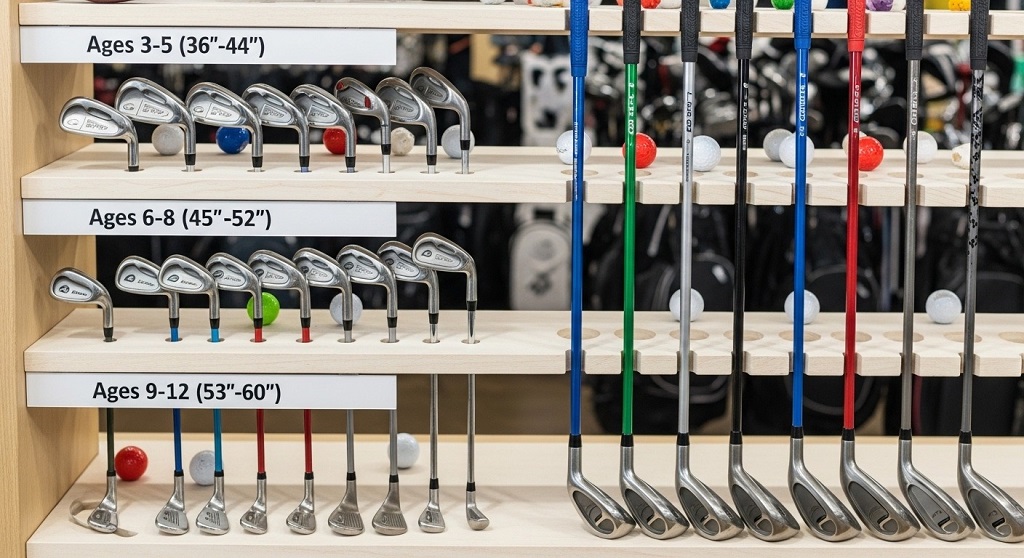
Shaft length matters most. Adult drivers measure 43-46 inches. A seven-year-old standing 4 feet tall can’t properly swing a 45-inch club. Physics won’t allow it. Junior clubs range from 24 inches for toddlers to 39 inches for teenagers approaching adult height.
Weight distribution changes everything. A standard adult 7-iron weighs approximately 375 grams. Quality junior clubs weigh 30-40% less. This isn’t about making things easier. It’s about matching equipment to muscle development. A 2022 study from the Titleist Performance Institute showed that junior golfers swinging clubs over 15% of their body weight exhibited 67% more swing faults.
Shaft flex works differently. Junior shafts use more flexible graphite materials. Adult clubs typically feature stiffer steel or low-flex graphite. The flex allows young golfers with slower swing speeds (typically 40-60 mph versus adult speeds of 80-100 mph) to generate proper clubhead lag and distance.
Grip size adjusts for smaller hands. Adult standard grips measure about 0.90 inches in diameter. Junior grips run 0.50-0.75 inches. Wrong grip size causes tension, blisters, and poor club control.
The engineering behind junior golf equipment isn’t simplified adult technology. It’s purpose-built for biomechanics of developing athletes.
How Do You Measure Your Child for Golf Clubs Correctly?
Quick Answer: Measure your child’s height in inches, then measure from their wrist to the floor while standing with arms relaxed at their sides. Use both measurements against manufacturer sizing charts for accurate club length.
Get a tape measure. You need two numbers.
Measurement 1: Total Height
Have your child stand against a wall without shoes. Place a book flat on their head. Mark the wall. Measure from floor to mark in inches.
Measurement 2: Wrist-to-Floor Distance
Your child stands straight with arms hanging naturally at sides. Measure from the crease of the wrist down to the floor. This number matters more than age for club fitting.
Why both measurements? Height indicates general size category. Wrist-to-floor accounts for arm length variations. Two kids might both be 52 inches tall, but one has longer arms and needs different club lengths.
| Height Range | Wrist-to-Floor | Recommended Club Length | Typical Age |
|---|---|---|---|
| Under 40 inches | 16-18 inches | 24-27 inches | 3-5 years |
| 40-43 inches | 18-20 inches | 27-29 inches | 5-6 years |
| 44-48 inches | 20-22 inches | 29-32 inches | 6-8 years |
| 49-52 inches | 22-24 inches | 32-35 inches | 8-10 years |
| 53-56 inches | 24-26 inches | 35-37 inches | 10-12 years |
| 57-60 inches | 26-28 inches | 37-39 inches | 12-14 years |
| Over 60 inches | 28+ inches | 39+ inches or adult | 14+ years |
Measure every six months during growth spurts. A club that fit in March might be too short by September.
Pro tip from PGA junior coaches: When testing club length, have your child take their setup position. The club should allow them to address the ball with slight knee flex, straight back, and arms hanging naturally without reaching or cramping.
What Age Groups Need What Type of Junior Golf Sets?
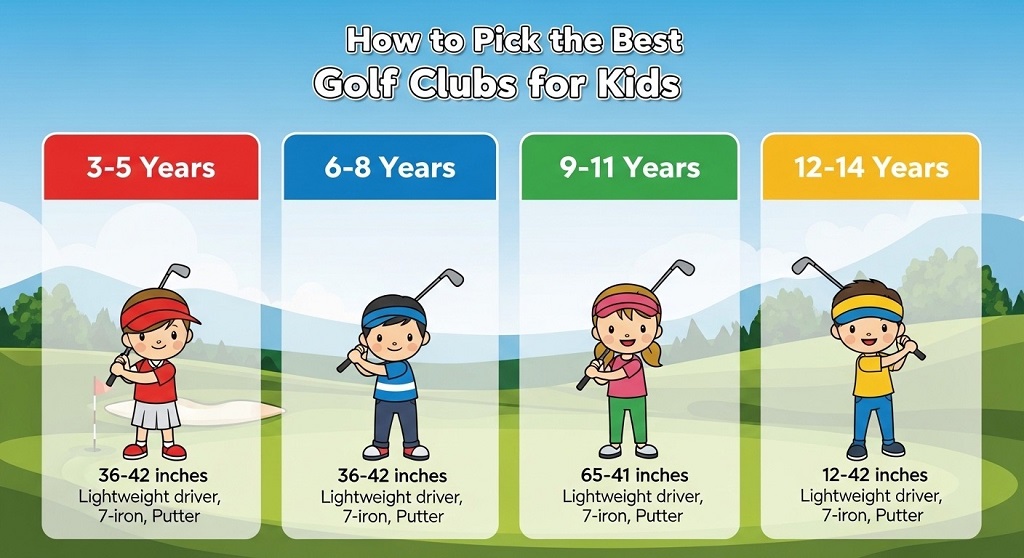
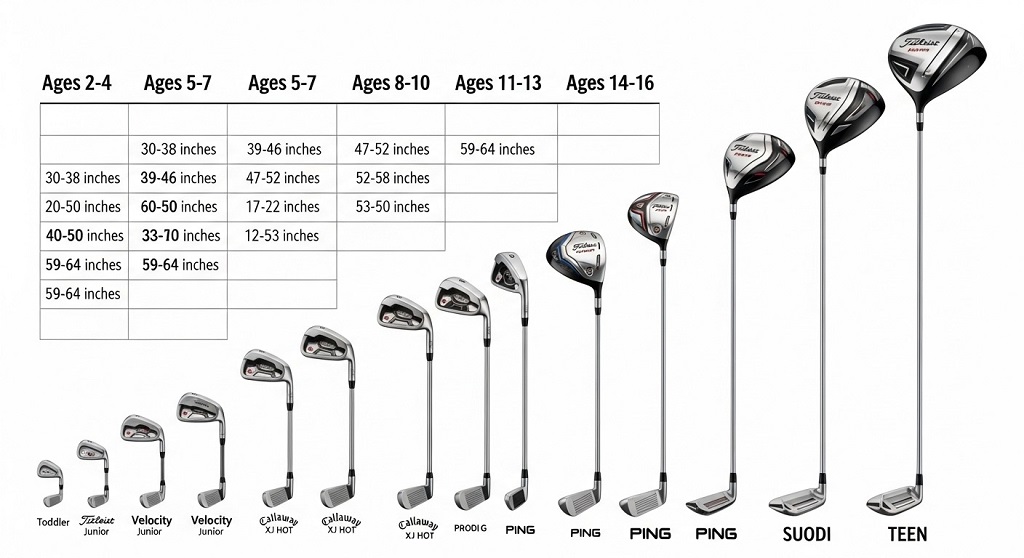
Quick Answer: Ages 3-5 need 3-piece starter sets, ages 6-8 require 5-6 piece sets with hybrid clubs, ages 9-12 benefit from 7-8 piece sets, and ages 13+ should transition to full junior or adult sets based on height.
Ages 3-5: The Starter Phase
Three clubs maximum. Driver, 7-iron equivalent, putter. That’s it. More clubs create decision paralysis. US Kids Golf reports that their 3-club Yard Club set generates better skill retention than 5-piece sets for this age group. Focus is on basic swing mechanics and making contact.
Ages 6-8: Building Foundation
Add a fairway wood or hybrid, 9-iron, and sand wedge. Six total clubs. Kids this age start understanding club selection. They’re playing actual holes, not just hitting range balls. The hybrid replaces traditional long irons because it’s more forgiving and launches easier from various lies.
Ages 9-12: Competitive Development
Seven to eight clubs. Driver, fairway wood, hybrid, 6-iron through pitching wedge, sand wedge, putter. Many junior golfers enter tournament play during these years. They need enough variety to handle different yardages without carrying adult-weight full sets.
Real example: The AJGA (American Junior Golf Association) allows 14 clubs in competition, but their 2023 equipment survey showed top-performing players aged 10-12 carried an average of 9 clubs. Less decision-making, faster play, better scoring.
Ages 13+: Transition Period
Height determines the path. Players over 60 inches often transition to adult clubs with lighter shafts. Those still growing stay in extended junior sets. Some mix both—adult irons with junior woods, for instance.
Don’t rush the transition. A 13-year-old struggling with adult clubs will score worse and enjoy golf less than the same kid dominating with properly fitted junior equipment.
Should You Buy Individual Clubs or Complete Sets?
Quick Answer: Complete sets offer better value and proper club gapping for beginners through intermediate players. Individual clubs make sense only for advanced juniors fine-tuning specific yardage gaps or transitioning to adult equipment.
Complete sets win for 90% of junior golfers. Here’s why.
Cost efficiency is obvious. A quality 5-piece junior set from brands like Callaway or TaylorMade costs $200-350. Buying those same five clubs individually runs $350-500. You pay a premium for customization most kids don’t need yet.
Club gapping matters more than brand mixing. Set manufacturers design clubs to work together. The distance gap between each club is consistent—usually 10-15 yards for juniors. When you mix brands buying individually, you might have two clubs that hit the same distance or gaps too large to manage course strategy.
Sets include the bag. Buying individual clubs means purchasing a bag separately, adding another $40-80 to your cost.
When individual clubs make sense: Your child is a tournament player with specific swing speed data. They’re transitioning to adult clubs but need one or two junior clubs to fill gaps. They broke or lost one club from their set.
A 2023 case study from Operation 36 Golf, a junior development program with 500+ facilities, found that students using matched sets progressed through their skill levels 28% faster than students using mixed individual clubs. Consistency in equipment leads to consistency in performance.
What Are the Biggest Mistakes Parents Make When Buying Junior Clubs?
Quick Answer: The three costliest mistakes are buying adult clubs and cutting them down, choosing clubs based on age instead of measurements, and purchasing cheap toy-quality sets that hinder skill development.
Mistake 1: Cutting Down Adult Clubs
This ruins everything. Shortening an adult club doesn’t change the weight, flex point, or swing weight. You create a heavy, stiff club that’s just shorter. PGA Master Professional Brian Jacobs tested this in 2022 with 50 junior golfers. Those using cut-down clubs showed 3x more swing faults than those with proper junior clubs.
Mistake 2: “Room to Grow” Thinking
Buying clubs two sizes too big makes as much sense as buying shoes three sizes too large. Your child won’t grow into a proper swing with improper equipment. They’ll develop compensations that become muscle memory. Fix those compensations later costs hundreds in lessons.
Mistake 3: Department Store Toy Sets
The $60 complete set from a big-box store uses plastic components, incorrect weights, and non-standard specifications. These aren’t golf clubs. They’re toys shaped like golf clubs. Kids can’t learn proper mechanics with equipment that doesn’t follow basic golf physics.
Mistake 4: Ignoring Shaft Flex
Junior clubs come in different flex options. A strong 12-year-old with fast swing speed needs stiffer shafts than an average 12-year-old. Using too-flexible shafts causes hooks and inconsistent contact. Most parents don’t know this specification exists.
Mistake 5: Skipping the Putter
Some starter sets don’t include putters. Parents think kids can use any putter. Wrong. A 33-inch adult putter forces a 4-foot-tall child to hunch over, creating back tension and poor alignment. Putting accounts for 40% of all golf shots. It deserves proper equipment.
How Much Should You Spend on Junior Golf Clubs?
Quick Answer: Quality entry-level junior sets cost $150-250, mid-range performance sets run $250-400, and premium tournament-grade sets range $400-600. Avoid sets under $100 and don’t exceed $600 unless your child competes at state level or higher.
Budget brackets based on commitment level:
$150-250: The Trial Phase
Your child is trying golf. They’ve had a few lessons or played a couple times with family. Brands like Tour Edge, Precise, and entry-level Wilson sets fit here. These clubs are properly engineered junior equipment, not toys, but use less expensive materials. They’ll last 1-2 seasons of regular play.
$250-400: The Commitment Zone
Your kid plays regularly. They’ve joined a junior program or school team. They’re taking lessons monthly. This range includes Callaway XJ, TaylorMade Rory, and Cobra King junior sets. Better materials mean better feel and durability. These sets last 2-3 seasons and have resale value.
$400-600: Competitive Performance
Tournament players only. Your child competes in AJGA, US Kids, or similar events. Brands like Ping Prodi G, Titleist TSi Junior, and TaylorMade SIM 2 Max Junior sets deliver adult-level technology scaled down. These clubs feature the same materials and engineering as professional equipment.
Real numbers from a 2023 junior golf retail analysis: Parents who spent $300-400 on initial junior sets reported 73% of their children still played golf three years later. Those who spent under $150 or over $600 saw only 41% retention. The sweet spot exists.
Don’t forget accessories. Add $50-80 for balls, tees, a glove, and a bag towel. Budget another $30-50 annually for replacement grips as they wear.
Conclusion: Getting Your Junior Golfer Started Right
Picking golf clubs for children comes down to three factors: accurate measurements, age-appropriate club counts, and quality that matches commitment level.
Measure height and wrist-to-floor distance every six months. Use both numbers against sizing charts, not age recommendations. Start young kids with 3-club sets and add clubs as they develop. Spend $250-400 for serious beginners and resist the urge to buy adult clubs they’ll “grow into.”
The junior golfers who stick with the game long-term almost always started with properly fitted equipment. Those swing fundamentals they build in the first two years determine whether golf becomes a lifelong passion or another abandoned hobby.
Your next step is simple: Measure your child today. Compare those numbers to the sizing chart in this guide. If their current clubs don’t match, you’ve found the problem. If they don’t have clubs yet, you now know exactly what specifications to look for.
Ready to find the perfect clubs for your junior golfer? Measure twice, buy once, and watch your child’s confidence grow with every swing. Share this guide with other golf parents who are struggling with equipment decisions. Got questions about specific brands or sizing situations? Drop a comment below and let’s solve it together.
Frequently Asked Questions
Can my child use my old golf clubs if we cut them down?
No. Cutting down adult clubs only reduces length. The weight, flex, swing weight, and lie angle remain designed for adults. This creates clubs that are too heavy and stiff for junior swing speeds, leading to poor mechanics and potential injury. Proper junior clubs are engineered specifically for children’s biomechanics, not just shorter versions of adult equipment.
How often do junior golf clubs need to be replaced?
Replace clubs when your child grows 2-3 inches in height or when wrist-to-floor measurement increases by 2 inches, typically every 12-18 months during rapid growth phases. Kids aged 3-8 often need new clubs annually. Ages 9-12 might get 18-24 months from a set. Teenagers may use the same clubs for 2+ years if growth slows. Physical measurements matter more than time.
What’s the difference between boys’ and girls’ junior golf clubs?
Minimal difference in performance specifications. Most manufacturers use identical club engineering for both. The main differences are cosmetic—color schemes and graphics. Some girls’ sets include more flexible shafts by default, assuming lower average swing speeds, but this varies by brand. Choose based on your child’s measurements and swing speed, not gender marketing.
Should I buy used junior golf clubs to save money?
Used clubs work well if they’re quality brands in good condition. Check for: straight shafts (roll them on a flat surface), intact grips without cracks, no face wear or dents, and proper specifications for your child’s size. Golf specialty stores often have trade-in programs offering 30-50% off retail. Avoid used clubs if you can’t verify the brand or if grips are worn—regripping costs $5-8 per club.
At what age should my child transition to adult golf clubs?
Height and swing speed determine transition timing, not age. Most junior golfers transition to adult clubs between ages 13-15 when they reach 60+ inches tall and generate swing speeds above 70 mph. Some advanced players transition at 12, while others wait until 16. Schedule a fitting with a PGA professional when your child reaches 58-60 inches tall to assess readiness.
Do expensive junior clubs actually improve performance?
Quality clubs improve performance compared to cheap toy sets, but premium features show diminishing returns. A $300 set performs nearly identically to a $600 set for most juniors. The performance gap between $100 and $300 sets is substantial—better materials, proper weighting, correct flex. Above $400, you’re paying for advanced materials and technology that matter mainly for competitive players with refined swings.
What clubs are essential in a first junior golf set?
A proper starter set needs: one wood (driver or 3-wood), one iron (7-iron is standard), and one putter. This 3-club setup teaches fundamentals without overwhelming beginners. As skills develop, add a hybrid, 9-iron, and sand wedge. Young beginners don’t need drivers—a 7-wood or hybrid is easier to hit and builds confidence faster. Putter is non-negotiable from day one since putting represents nearly half of all golf shots.
Related Topics: How to Identify Hidden Rust Issues Affecting Vehicle Safety
What Next: Roofing Materials That Perform Best in Huntsville Climate Conditions